
When to Use Video Remote Interpreting (VRI): ADA Accessibility Services Explained

When to Use Video Remote (Virtual) Interpreting

Here at Birnbaum Interpreting Services, we are deliberate in the types of accessibility services we offer and how we consult our clients to serve Deaf consumers. Unlike many other agencies, BIS puts service quality above all. We ensure that our Sign Language Interpreting, CART Captioning, and other service offerings are appropriate for the circumstances.

One of the biggest questions our clients face is whether to provide Onsite or Remote Sign Language Interpreting or CART Captioning. Many variables play a role in determining the correct service type. Today, Birnbaum Interpreting Services will focus specifically on the question of whether to provide Onsite or Remote Interpreting, known in the industry and among Deaf consumers are Video Remote Interpreting, Virtual Interpreting, or VRI.

The History of Video Remote Interpreting Services

The question of whether to provide or consumer Onsite vs. Remote Sign Language Interpreting services has existed since the dawn of Video Remote Interpreting (VRI). Since then many changes have taken place as pertains to culture, technology, and industry, all of which have influenced the Deaf community’s perspective and the ability of agencies and service providers to leverage Remote Interpreting services.

Birnbaum Interpreting Services was one of the very first Deaf access agencies to offer VRI. We began offering VRI circa 1997, and three years later we even got into the Video Relay Service industry, which is essentially like VRI for the telephone.

VRI was eschewed by the Deaf community at its nascence. It would be reductive to describe the reaction of Deaf service consumers as merely being fearful of a new technology. There was a visceral aversion to the limitations—both real and perceived—of a sign language interpreter who was stuck within a two-dimensional frame. Consider a scenario in which you’re trying to watch your child’s lecture during bring-your-parent-to-work-day. Or if you’re visiting a doctor, who’s about to give you incredibly important and personal news. In both scenarios—and for both similar and very different reasons—the last thing you want to be doing is staring at a screen while your child is in front of the class or your family is by your side.

These sentiments were shared by many sign language interpreters as well. Interpreters resented the idea or experience of sitting in an office all day, interactions limited to only the consumers who appeared on their screens. Interpreters also tend to support the Deaf community. If Deaf consumers preferred Onsite Sign Language Interpreting, so did the interpreters. It was only natural given that a large proportion of interpreters were either CODA (children of Deaf adults) or had gotten into the industry because of a passion for serving Deaf people.

But this isn’t to say that a fear of this new technology didn’t exist. We know it did, mostly because of what happened later. The pandemic forced people out of workplaces, doctor’s offices, banks, and social events and into their homes. With platforms such as Zoom and Teams offering the only portal to the outside world, VRI became the Deaf population’s only method of attaining accessibility.

As the pandemic abated, Onsite Interpreting started to come back—but not nearly to prior levels. The effect on sign language interpreters was perhaps even more dramatic. A serious shortage of Onsite interpreters developed, exacerbating an already chronic problem. While the Deaf community has come to embrace VRI, it’s perhaps not to the degree that has been imposed upon our consumers by the industry.

Onsite Sign Language Interpreting vs. VRI: How to Decide

Birnbaum Interpreting Services is Deaf-founded, CODA-operated, and staffed by an administration of native signers. Nearly every member of our team has confronted, themselves or via family and friends, an attempt on behalf of a hospital or school to foist upon them a virtual interpreter.

It’s impossible to create hard and fast rules for every type of request. There are simply too many potential scenarios. But it’s equally important that the organization responsible for providing access to hew to ADA, which demands reasonable accommodation. As a Deaf access agency with skin in the game, we consult with our clients on this decision on nearly a daily basis.

The most effective way to determine whether a Deaf consumer requires Onsite or Remote Sign Language Interpreting is to follow a set of guidelines:

  1. If it’s personal, it’s in person: The scenario at the doctor’s office is just one example. People don’t want to stare at a screen during their most momentous experiences. When buying a new home, at graduation, or at a funeral, the interpreter should be present.
  2. When VRI is impractical or unacceptable: In many situations VRI is either unfeasible or outright egregious. A mother giving birth should not be forced to somehow communicate with a screen—and yet this happens on a daily basis. Theatrical performances, manual labor in mills, mines, warehouses, and factories, and walking tours. If it’s inappropriate or downright impossible to focus on a screen and engage in the activity, VRI doesn’t work.
  3. Abiding preference: Sign Language Interpreting shouldn’t be different than any other business in that the customer is always right. This goes well beyond Onsite vs. Remote Sign Language Interpreting. Some reasons are absolute, such as a Deaf-Blind consumer who requires Tactile or Protactile interpreting services. (Pro/Tactile interpreting involved signing into the consumer’s hand, which cannot be performed remotely.) As with many service industries, the success of interpreting service rests largely on consumer preference, whether related to style, dialect, or inexplicable factors that have little to do with skill and everything to do with personal preferences. The same goes for Onsite vs. VRI. If a Deaf consumer prefers Onsite, reasonable effort should be made to acquiesce.
  4. Doing what’s right vs. what’s easy: It can be difficult you as a client to discern whether it’s practical or feasible to get an interpreter Onsite. You’re relying on agencies like us to figure that out for you—yet too many agencies try to push VRI on clients or consumers, even when it’s not appropriate and/or an Onsite interpreter can be made available. It’s important to work with an agency with skin in the game—i.e. a provider run by Deaf, CODA, or at least culturally engaged individuals who truly care about outcomes for the Deaf population. As a Deaf-founded and CODA-operated agency run by and for the Deaf community, BIS is always looking out for our clients’ and consumers’ best interests.

It’s impossible to provide hard and fast rules that determine when to use Onsite vs. Remote Sign Language Interpreting services. But following the above set of guidelines will go a long way.

The Importance of VRI: When Preference Can’t Be Met

The third guideline noted above states that we should provide Onsite interpreters to meet consumer preference. The reality of the Deaf access industry is that we can’t always provide exactly what the consumer wants. There simply aren’t enough interpreters.

Lead time and location are the most frequently limiting factors. VRI offers an incredibly resource that has revolutionized accessibility. Even as few as 15-20 years ago, it was impossible to provide interpreting services in a wide range of situations. With VRI, we can now access an interpreter anywhere in the world. Birnbaum Interpreting Services offers On-Demand VRI for consumers any place, any time.

We should always try to meet preferences. But when we can’t, accessibility comes first. Whether it be a last-minute request for a Zoom meeting or a request for service in a very rural area with few or no qualified interpreters, VRI can be a miraculous resource.

Birnbaum Interpreting Services Works with Clients & Consumers

Deciding whether to provide Onsite Sign Language Interpreting or Video Remote Interpreting is more complicated than it may appear. Circumstances and consumer need should dictate whether an interpreter provides Onsite or Remote service. But sometimes it can be tricky.

Here at Birnbaum Interpreting Services, we ensure that you have the tools you need to provide the most appropriate service. Most importantly, we work with our clients and consumers to find the right solution. If there isn’t enough time or resources to locate an Onsite Sign Language Interpreter, BIS can provide On-Demand VRI, which we staff with some of the best and most experienced interpreters in the industry. However, we offer VRI only when it’s preferred or absolutely necessary.

 

State Licensure for Sign Language Interpreters: Good or Bad?

State Licensure for Sign Language Interpreters: Good or Bad?

Birnbaum Interpreting Services (BIS) has been a Deaf access agency headquartered in Maryland since David Birnbaum opened our doors in 1995. One of the first—if not the first—Deaf-founded Sign Language Interpreting agencies in the United States of America, BIS is now run by David’s son, Brian, alongside an administration replete with Deaf, CODA, and other culturally native staff who collectively carry more than 100 years of combined industry experience.

All of this is to say that Birnbaum Interpreting Services knows a thing or two about Deaf access and culture. Furthermore, our team has spoken to countless industry peers and thought leaders, almost each one of whom have echoed our sentiments.

What follows is a minimally edited version of the comments that BIS submitted to the Maryland State Board of Sign Language Interpreters with regard to the forthcoming requirement that all interpreters working in the State of MD obtain a State license. Neither Birnbaum Interpreting Services nor Brian himself have yet to receive any response to or acknowledgement of these comments. Nonetheless, the severity of the consequences from this legislation cannot be overstated, so we deem it imperative to share the risks that the State’s Deaf population face once this legislation goes into effect.

Important Disclaimer

BIS is a nationwide provider. Only ~10% of our business takes place in the State of Maryland. Further, given the details of this legislation, it’s highly unlikely to affect our existing business with the State. Our note to the State Board comes from a place of concern not for our financial situation but for that of Maryland’s Deaf and Hard-of-Hearing population—of which includes many of our staff, family, and friends, all of whom will as a result lose access to the interpreting services guaranteed them by ADA. 

There is no ambiguity about this fact; the shortage of resources will be multiplied by 10 or 20.

State Licensure for Sign Language Interpreters: Consummately Bad

The recently passed legislation is overwhelmingly detrimental to the Deaf community in the State of MD. First, any improvements upon quality will be imperceptible, and in fact it’s far more likely that quality will plummet. Why? To obtain a State license interpreters must first obtain an RID or equivalent license. This largely makes the State license redundant. But it also renders dozens, if not hundreds if uncertified yet highly qualified interpreter unable to serve in an industry already experiencing a chronic shortage of interpreters.

Rather than resolving the root problem in our industry—the lack of qualified interpreters—it focuses instead on the symptoms—occasional poor quality—which will exacerbate the problem by orders of magnitude.

The increased shortage effectively guarantees that Deaf individuals will go without service across innumerable situations. Every CODA on the BIS team has experienced waiting with their parents in the hospital for days before an interpreter arrived, and each of us fully expects this problem to be exacerbated.

And this is just the beginning of the legislation’s issues.

Problems with the State Licensure for Sign Language Interpreters

The team here at Birnbaum Interpreting Services sat down to discuss the problems the Deaf population faces because of the incoming licensure requirement. Below, we list the most salient issues, beginning with an expanded version of the licensure’s counterproductive redundancy before moving into deeper and more serious damages waiting to be incurred on an already marginalized population.

As we discuss below, the State has legislated this requirement without consulting the industry’s participants and true experts all in the name of increasing tax revenue by less than 0.0007% per year.

  1. This legislation is the definition of throwing the baby out with the bath water; it’s tantamount to adding another 10 years of medical school because a couple of doctors were sued for malpractice. The solution simply exacerbates the “problem,” which isn’t really a problem to begin with. 99% of BIS interpreters are qualified and do a great job; the other 1% are either new and learning or an unfortunately rare occurrence of incompetence, to which no industry is 100% immune. And unlike being a doctor, interpreting work is highly personalized and at least as much art as science; there are hundreds of high-quality, uncertified interpreters who will suddenly evaporate from Maryland’s industry. Half of them will take years to obtain their state licenses, and the other half will simply walk away. In the interim, the problem will be massive.

The State licensure requirement will exacerbate—by orders of magnitude—the critical shortage of interpreters available across the State of Maryland. Deaf and Hard-of-Hearing people will be forced to go without service or seek services from unlicensed interpreters, namely family and friends. The vast majority will choose the latter, or else they will not be able to function. They will also be forced to rely on friends and family, despite this going directly against ADA law.

We see at least 30-40% of Onsite assignments going unfilled. These numbers will easily double as a result of this legislation.

2. The requirement to carry or obtain an RID license prior to obtaining a State license completely neutralizes any benefits from the State licenseIf an RID license—which is the nationally recognized body—is required, what is the point of the state license? There’s now zero value added for holding the state license, and yet it’s required to work in the State of MD.

Further, RID licensure only goes so far in ensuring quality. A dual license requirement will provide little if any additional quality constraints while eliminating hundreds of qualified interpreters from the marketplace.

We screen hundreds of interpreters a year. We have reliably found little correlation between certification and quality, and far higher correlation between traits such as responsibility or ethics and quality. Yet many interpreters high in these presentations refuse to obtain certifications because they deem them as financially exploitative and therefore prejudiced against marginalized interpreters. Certifications, in many ways, add arbitrary barriers to entry, when many interpreters can’t even afford them to begin with. Now the State is asking interpreters to double that outlay just to begin working. The numbers of marginalized interpreters will only suffer more.

3. The requirement for Video Remote Interpreting (VRI) resources to hold State licenses is perhaps the most damaging and illogical aspect of the legislation. Formerly a safe haven for when Onsite interpreters aren’t available, VRI service will experience the same dearth of interpreting resources as Onsite—again, with little to no benefit to consumers.

VRI is used in some of the most important situations because of the ability to use digital devices to draw up an interpreter On-Call. Emergency rooms, police stations, court rooms—the list goes on. The number of sign language interpreters working from outside the State—in any state—dwarfs the number working in State. This is simple math and probability, given that VRI interpreters can be drawn from anywhere. Therefore, mathematically, this legislation effectively reduces the pool of VRI interpreters available to Maryland’s Deaf residents by roughly 98%.

4. Prices will increase far beyond inflation rates. Whether or not interpreters are yet aware, they will easily be able to charge higher rates because of the exponential decrease in supply. How the State of MD expects small businesses, hospitals, and nonprofits to pay for these increases is unclear. 

5. The D/HH community will lash out. We’ve already seen this at the Board’s commentary events, which has been met with outright indifference. We see no path to a properly functioning marketplace. The D/HH population will suffer for a long time, and, even when supply increases, any quality gains will never be enough to compensate for the permanent shortfall. It’s out hope that the Deaf community will research the causes behind these changes and take action against those who perpetrated them. There is a very long history of this in the Deaf community.

Problems with the Process of Legislating the Licensure Requirement:

We’ve done our best to cover the range of issues that should have prevented the State of Maryland from even considering this legislation. But there should have been plenty of opportunities to understand the consequences during the process of proposing, studying, debating, and passing it.

Unfortunately, what we have found thus far is that none of the Board members are even acknowledging the issues we’ve raised. We’ve sent emails detailing the issues. We’ve made commentary. We’ve cited clients who work for the State of MD’s Administration of the Courts. Other agencies and interpreters have been screaming for a pause.

None of this has mattered to the Board or the State.

  1. There was and there remains virtually no communication—let alone cooperation—with industry participants leading up to the formation—let alone passing—of this legislation. As an agency that’s been in business for 30 years and is known throughout the country, BIS should have been one of the first calls. None of the other agencies working in the State have reported cooperation or collaboration.

By simply working with the participating, active experts in the industry the Board would have been swiftly and overwhelmingly advised to pursue a diametrically opposite course of action, and instead make it easier for interpreters to obtain certifications.

2. The communication following the passage of the legislation has been equally poor. Neither agencies nor interpreters are informed about hearings, rule changes, or updates. The Board should be working with the providers of Sign Language Interpreting services.

3. The hearings and meetings have been completely devoid of any attempt to understand the flaws of the legislation. There’s little attempt to communicate with the Deaf community or the industry experts. A few paltry minutes are given to one or two individuals to rebut the legislation, which goes virtually unheeded.

4. It can only be assumed that analogues for this legislation were other State licensures. The problems here are nearly impossible to encapsulate. First, states that passed licensure requirements have seen immense damage visited upon their Deaf and HH populations.  Any statistics gathered don’t even begin to reveal the damage given that the uncovered consumers are, necessarily, not being reported; the vast majority of these consumers are not bothering to get an interpreter, and the states are not bothering to record these instances any way.

Birnbaum Interpreting Services serves all 50 states. Each of the states that require licenses or registrations are more difficult to fill, in direct correlation with the difficulties reported in obtaining the licenses. We speak to consumers, friends, family, and industry participants. The reports are universal and vehement.

Yet this fact alone doesn’t even begin to reveal the absurdity of using other state licensure programs as models for the State of Maryland—which has one of the highest Deaf populations in the world. The difficulties seen in other states with licensure requirements pale in comparison to what we will see in Maryland. With an existing chronic shortage, this legislation will break the population’s ability to gain access.

There are many more reasons why this legislation will be an overwhelming net detriment to the D/HH community. We hope that the Board will reconsider their position and implement a plan that makes sense for the community—namely, one that addresses the shortfall of supply rather, which is the root cause of the lack of quality.

The Deaf Population and Providers of Access Services Must Fight

The legislation has passed. Dates have been set. While it’s unlikely the Board or State will change its minds, we can fight this licensure requirement the best we can.

The most important thing is to keep record of your experience. Whether you’re a Deaf consumer of Sign Language Interpreting services, a provider, or a friend or family member of either or both, it’s imperative that you keep track of your experience. The more data we aggregate, the more compelling the movement to rescind this legislation becomes.

We must also do our best to follow the new laws. Despite how harmful it is to the Deaf population, the best way to reveal the harm is to keep out the contaminants. We are not suggesting that you go without service or go without providing service. However, we must put forth a good faith effort to follow the legislation, or we cannot prove that the regulations are impossible to follow without incurring severe damage to the Deaf population.

Lastly, we must all work together. This is the most difficult of all, particularly for the access agencies who also must compete for business. This legislation will only make things more difficult for everyone. By fortifying, barbing, and building higher our fences, we only exacerbate the challenges ahead. If we instead communicate, collaborate, and support each other, we can pool our resources and records to create a better record of the consequences of this myopic legislation.

Contact Birnbaum Interpreting Services with any Questions, Concerns, or Service Needs

Birnbaum Interpreting Services has been in business for three decades and counting. When we first opened our doors, we were one of very few agencies, with far fewer sign language interpreters in the area. We have seen our fair share of challenges. And we have overcome each of them.

Our team is prepared to confront this next challenge. We’re here to help. Whether you have questions or concerns about the new licensure requirements, our services, or how we can consult with your Deaf access needs, please don’t hesitate to reach out via phone or our contact page.

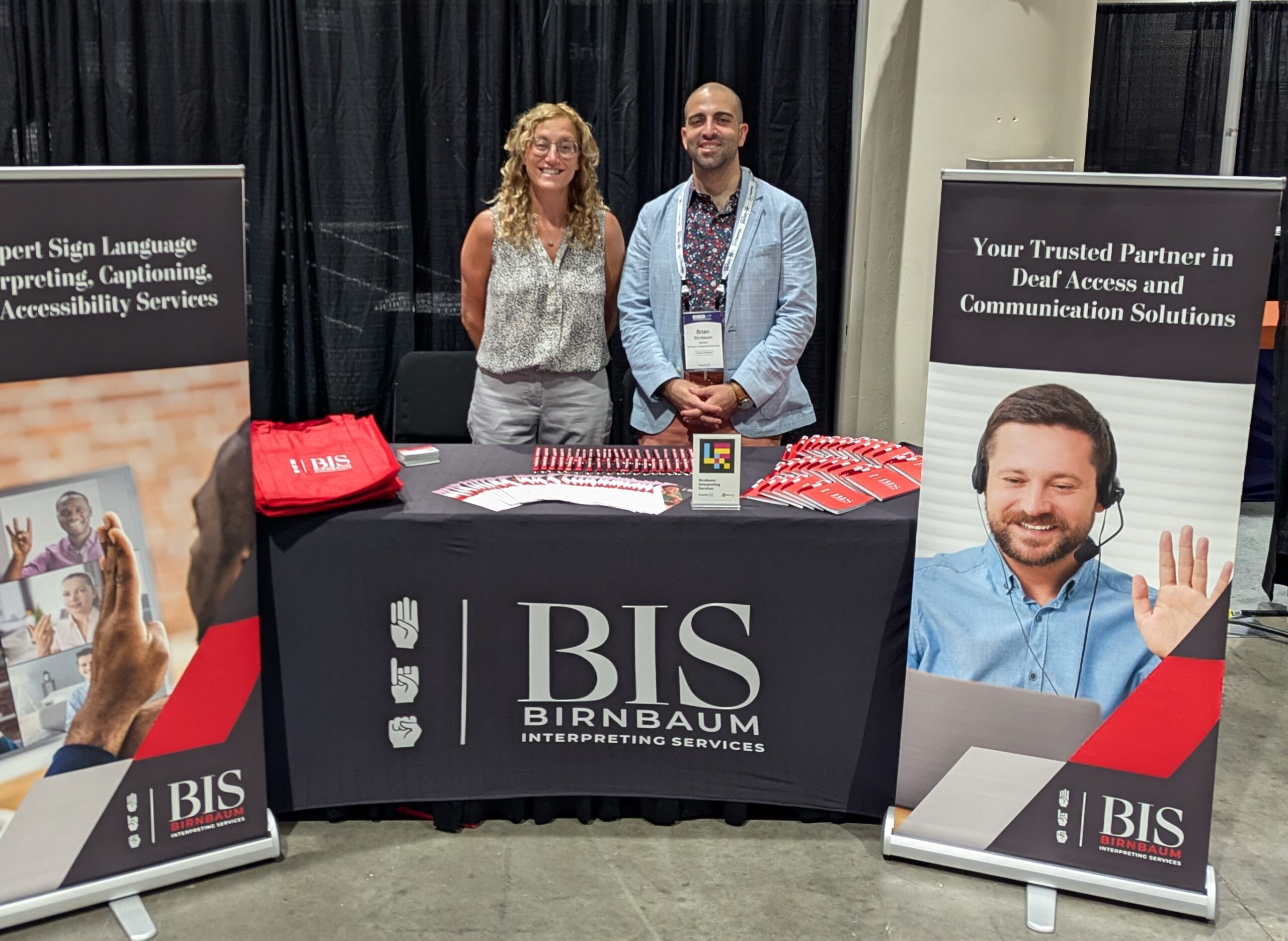
From Transaction to Connection: Reflections from Disability:IN

Reflections from Disability:IN

Brian Birnbaum
CEO, Birnbaum Interpreting Services

My perspective on conferences changed over the few days I spent at Disability:IN. I thought I understood why I go to conferences. You show up, network, try to walk away with new business, or at least new leads. That’s what you’re supposed to do, right? And because that wasn’t something I naturally gravitated toward, I used to think I just wasn’t a good salesperson. I’ve always prioritized connection in my personal life, but I placed a clear boundary between that and my professional world.But something shifted for me during those few days.

It started with a conversation I had with another Brian I met at the conference, the director of a major supplier/vendor program. I went in with the “hard sell.” Asked about Deaf employees, accessibility services, and upcoming RFPs. He shut me down immediately, and honestly, I’m glad he did.It was the best thing that could’ve happened; that moment flipped a switch.Once I dropped the pitch and acknowledged what had happened, we actually started connecting. We talked about our journeys, how he came to his current company, and how I came to lead BIS. We talked about purpose, inclusion, access, and why we do this work.

And I realized: no one remembers the pitch. What they remember is the feeling. The connection. The moment.

I carried that with me through the rest of the event. I noticed the most meaningful conversations happened when business wasn’t even on the table. Like the one we had over dinner with Ander from Andersen Windows, where we talked for hours, about life, about vulnerability, about what really matters.That’s the kind of connection I want BIS to be known for. Not just as a vendor, but as a mission-driven partner who brings people-first energy and lives out our values of empathy, access, and authentic inclusion.
To get the full picture, I interviewed three people who joined me at the conference, Connie, our VP of Operations, Mark Byrne, our fractional Accessibility Consultant, and Clare, who was our event consultant, to invite them to share their own reflections from the conference.What they each experienced, in very different ways, brought home the core truth that access isn’t just about compliance, it’s about dignity, agency, and how people feel in every interaction.

Mark Byrne

Mark, can you share a bit about your experience attending Disability:IN? It was your first time, right?

“It was a moment of panic, and then perspective. I wasn’t ready for that moment, but I’m grateful it happened.”

— Mark Byrne

“Sure, Brian, I’ll share a moment and share a little about something I didn’t expect. I was walking the floor, doing what we do, introducing myself, saying hi, explaining who we are, and what we do.

And I walked up to a booth, and the person at the table greeted me in sign language. I just froze. Like, a wave of panic came over me. I wanted to respond, I wanted to connect, but I wasn’t equipped for that moment.

I didn’t know how to apologize or where to look for help, or what to do next. And for a minute, I felt kind of helpless.

Later that night, I was back in my hotel room thinking about the day, and that moment really stuck with me. And I realized, yeah, that feeling I had? That’s what so many Deaf or hard-of-hearing folks probably experience on a regular basis.

That discomfort, that disconnect.

I was lucky, you were nearby, and you came over and interpreted for me. We ended up having a great conversation. But I keep thinking about how important that was for me, personally.

It kind of hit me that even though I work in accessibility, in language access, in sales, I don’t always sit in the end-user experience. I’m focused on deals and partnerships, and outcomes.

But that moment, it reminded me: we’re in a privileged space at BIS. What we do, helping people access healthcare, education, basic life services, it matters.

It’s not just what we offer; it’s what it makes possible for others.”

Clare Schmitt

Clare, you helped guide our event strategy and support our presence during the rebrand rollout, but this experience seemed to hit home for you in an unexpected way. Can you walk us through what happened at the booth?

“Inclusion isn’t about accommodating people. It’s about building environments where no one ever feels excluded in the first place.”

— Clare Schmitt

“One of the most powerful conversations I had at Disability:IN was also one of the most unexpected. I don’t do much consulting anymore, but when you approached me with this opportunity to support BIS with the rebrand and event strategy, I said yes.

As a teenager, I lived with my aunt, who supported adults with disabilities in a group home she founded, so inclusion has always been one of my core values from a young age.

So I was working the booth, and this man comes over and starts signing to me. And I froze. I don’t sign. Yet. I panicked for a second.

But Connie, our VP of Operations, was there with me, and she immediately stepped in. I spoke; she signed. He signed; she interpreted.

It was a little awkward at first, he mentioned his daughter was studying to be an ASL interpreter, and then he kind of surprised me. He just looked at me and said, ‘So tell me what’s different about BIS.’

So I turn to Connie, thinking she’s going to take this, but he says, “No, you.” So I did! I gave my spiel, really, I gave my heart.

I talked about who we are, what we do, and why this work matters. Connie signed everything, and he responded, and Connie signed back.

And the three of us just… had a conversation. By the end, it felt normal. Like, truly, beautifully normal.

What started as an awkward, unfamiliar moment became the most natural, engaging conversation of the day.

What I realized later is that I was the one in that moment who felt like the outsider. Not because of anything anyone did, but because I couldn’t communicate fluently in that setting.

And that moment was the highlight of the conference for me. I’ve told that story a dozen times since.

Because it made something tangible that we talk about all the time in theory: inclusion isn’t about accommodating people. It’s about building environments where no one ever feels excluded in the first place.

I came away with a renewed sense of purpose and a deep respect for the kind of inclusive design BIS champions.”

What Clare described is what true inclusion looks like in practice. It’s not just about offering services, it’s about shaping environments where everyone feels seen, heard, and empowered from the start. That’s the line we walk every day at BIS. We don’t just meet the moment; we shape it, by designing for belonging from the beginning.

What We’re Taking With Us

At the end of the day, we left Disability:IN with something far more important than a stack of business cards or a list of leads: renewed clarity on why we do this.

We walked away, reminded that the most meaningful outcomes don’t come from transactions; they come from shared purpose, mutual respect, and authentic connection.

At BIS, we don’t exist to pitch services. We exist to build trust. To create conversations that might not happen otherwise. To make sure that no one feels like they’re on the outside looking in.

This work is deeply personal. Whether we’re helping a parent engage in their child’s education or ensuring someone can fully participate in a work event, we’re not just providing a service.

We’re saying: you belong here.

And that’s something no pitch can ever fully capture.

It starts with us. With how we listen. With how we lead. With how we connect.

Birnbaum Interpreting Services: Washington D.C.’s Best Deaf Access Provider

Birnbaum Interpreting Services

As a pioneering Deaf entrepreneur, David Birnbaum founded Birnbaum Interpreting Services on the basis that it should first be steeped in Deaf culture and therefore best able to serve its accessibility needs. Headquartered in the Washington, D.C. metro area, Birnbaum Interpreting Services (BIS) has since expanded services to include several forms of accessibility, from our core sign language interpreting business to spoken language and transcription services—only providing the most qualified, certified, and experienced access resources.However, Birnbaum Interpreting Services will always been rooted in Deaf culture. Since opening in 1995, we have been Deaf-owned and operated. With Brian Birnbaum recently taking the lead as CEO, Birnbaum Interpreting Services is now CODA-led (Child of Deaf Adults), with nearly every staff member either Deaf or CODA.BIS provides everything from sign language interpreting to captioning and foreign language translation. Today, we’ll talk about who we are and why we’re Washington, D.C.’s best Deaf access provider.

BIS Origins

BIS reached its first agreement with the National Oceanic and Atmospheric Administration (NOAA) over 27 years ago. Since then, BIS has developed an unparalleled database of nationally certified interpreters and captioners whose technical capabilities represent the vanguard of the access industry.

BIS Services & Customers

Birnbaum Interpreting Services provides Deaf access and foreign translation services for a wide variety of customers. Our services include:

  • Onsite sign language interpreting
  • Video remote interpreting (VRI)
  • Remote live captioning
  • Onsite live captioning
  • Post-production and closed captioning
  • Foreign language interpreting
  • Document translation
  • Over-the-phone interpreting (OPI)
  • Deaf consulting services

Birnbaum Interpreting Services provides the services listed above for clients throughout countless industries, sectors, and all levels of government:

  • Federal government
  • State & local government
  • Education
  • Commercial businesses

From federal contracts with dozens of agencies and departments to the federal government’s biggest contractors like Booz Allen Hamilton, Birnbaum Interpreting Services can do it all.

Give us a call or visit us online to learn more about how we can help you with your interpreting and translation needs.

Birnbaum Interpreting Services Standard of Excellence

Trained, Certified & Experienced Interpreters and Captioners

Birnbaum Interpreting Services works with a pool of thousands of trained, certified, and experienced interpreters and captioners nationwide. Our interpreters and captioners boast the highest levels of training and certification, including but not limited to:

  • Registry of Interpreters for the Deaf
  • National Association of the Deaf
  • Comprehensive Skills Certification
  • Certificate of Interpretation
  • Registered Professional Reporter
  • Certified Real-Time Reporter
  • Certified Real-Time Captioner
  • National Court Reports Association

BIS has continuing education and professional development programs for staff and partners. We also have a zero-tolerance policy when it comes to the Registry for Interpreters for the Deaf (RID) Code of Professional Conduct.

Resource Matching

Birnbaum Interpreting Services is known for providing only the most qualified and suitably interpreters for each assignment. We’re able to accomplish this in large part due to our integrated coordination system.

Our integrated system uses historical data and metanalysis to match the best and most suitable resources for any request, whether it’s interpreting, captioning, or translation. Our system has retained decades of job data, complete with countless details that allow us to match the best resources.

Technical government assignments require a different skill set from medical appointments at a private practice. While most Deaf access and translation agencies use whoever is available, BIS does everything we can to assign the right resources for the job.

Our coordination system integrates all imaginable operations, from dialect specification and job notes to cross-referenced quality control mechanisms, under one digital umbrella. This holistic approach has been revolutionary, helping BIS provide thousands of clients with tens of thousands of hours of sign language interpreting and captioning services.

Recent Developments: Federal Relay Services

Birnbaum Interpreting Services has been one of the nation’s most trusted access providers for the federal government. We currently work with a score of federal agencies and departments including but not limited to the Department of Agriculture, Internal Revenue Service, Department of the Interior, Department of Justice, and many more.

Only a high-quality, trusted Deaf access agency works with so many important institutions for such a long period of time.

Our recent Federal Relay service contracts with over a dozen agencies includes state-of-the-art video remote interpreting (VRI) and remote captioning (CART & RCC) services.

From our headquarters in the Washington, D.C. metro area, along with call centers in Wisconsin and Louisiana, Birnbaum Interpreting Services provides more than 70,000 minutes of VRI and remote captioning per month.

Birnbaum Interpreting Services has taken over the majority of FedRelay services formerly contracted to international communications company, Sprint.

Again—only a company as trusted as Birnbaum would be trusted to take over such a crucial contract, which thousands of Deaf, low-vision, and foreign language speakers rely on daily for access to everyday work.

Reach out to Birnbaum Interpreting Services Today!

Birnbaum Interpreting Services reached its first agreement with the National Oceanic and Atmospheric Administration over 27 years ago. Since then, BIS has developed an unparalleled database of nationally certified interpreters, captioners, and translators whose technical capabilities represent the vanguard of the access industry.

Reach out to us today for more information about how we can help you with your access needs.